
Is your traditional sales funnel accelerating pipeline, or holding your revenue team back?
For B2B organizations navigating hyper-complex buying cycles, the traditional linear model (Lead MQL SQL) is rapidly proving obsolete.
At Dreamforce 2026, our team hosted a live panel exploring how Vinci, a simulation physics software company, discarded the traditional funnel entirely. In its place, Vinci designed a semi-autonomous, account-based growth engine that turns real-time market signals into automated, tailored go-to-market execution.
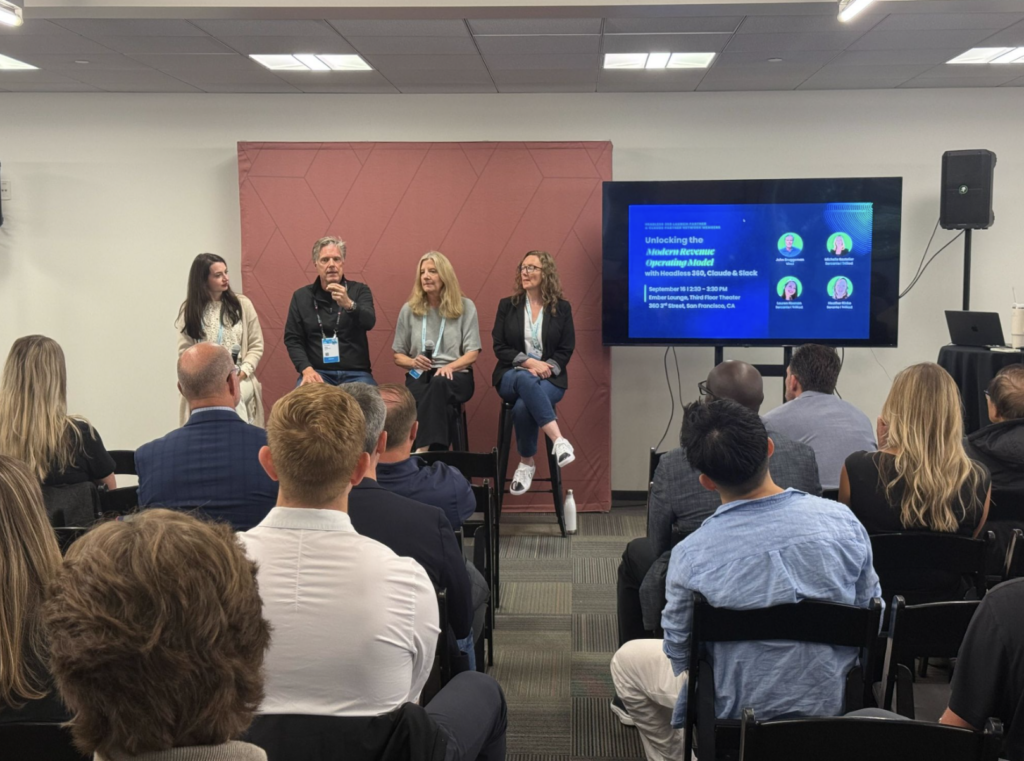
Speakers from left to right: Lauren Noonan, VP, Growth & Alliances, Sercante l Trilliad, John Bruggeman, CMO, Vinci, Michelle Bastelier, VP, GTM Strategic Consulting, Sercante l Trilliad, and Heather Rinke, Director, CRM Technologies, Sercante l Trilliad
Here is a breakdown of how Vinci envisioned this engine in under five months – and how revenue operations, sales, and marketing leaders can apply these principles to their own AI transformation strategy to establish a modern Revenue Operating System (OS).
The Challenge: Complex Buyers in a Pure ABM Market
Selling specialized, highly technical technology isn’t a numbers game. Vinci operates in a concentrated B2B market:
- A Finite Target Audience: They target ~500 named accounts that represent their entire prospect universe for two-year cycles.
- Hyper-Specific Buying Personas: Buyers are niche technical experts (e.g., engineers focused on semiconductor thermodynamics) buried deep within massive enterprises.
- Long Onboarding Ramps: Onboarding traditional sales and marketing talent to speak fluently to these buyers can take upwards of 12 months.
Relying on standard MQL forms and generic email nurture streams was simply insufficient for this sales motion. Vinci needed a model that listened for precise intent signals, identified key participants across the buying matrix, and enabled sellers to act instantly with tailored, highly accurate materials.
The Solution: A Semi-Autonomous Growth Engine
Rather than waiting for prospects to fill out forms, Vinci designed a growth engine that continuously scans the market, including news, events, social touchpoints, and meeting transcripts, for intent signals.
How the Engine Was Designed:
- Signal Aggregation & Intent Capture: Multiple LLMs (such as Anthropic Claude) ingest external signals (e.g., LinkedIn posts, media, industry conferences) and internal interaction data (Google Workspace, Notion meeting notes, transcriptions) to flag buying intent.
- Automated Play Execution: When an intent signal is triggered, AI agents execute pre-defined “plays”. The engine automatically pulls together custom presentation decks, tailored meeting agendas, and relevant product context.
- Slack-Native Delivery: Insights and generated collateral are delivered directly into Slack, where Vinci’s go-to-market teams work daily.
- Human-in-the-Loop Governance: The solution is semi-autonomous. While AI does the heavy lifting of gathering signals and drafting outreach materials, human team members review, approve, and send every piece of communication.
- Post-Meeting Automation: Seconds after a meeting ends, the system reviews the transcript, compares it against slide edits made during the call, and pushes recommended follow-up kits via Slack for the account manager to approve and send.
“Our account managers sort of have a co-seller with them in every single meeting… All of that heavy lifting is handled through the LLM underneath, delivered right in the workflow where the team operates.”
— John Bruggeman, CMO, Vinci
3 Pillars for Building an Intent-Driven Engine
During the Dreamforce panel, the team shared critical takeaways for RevOps and executive leaders planning to modernize their GTM architecture and revenue operating model:
1. Evaluate Strategy Before Technology
A common mistake in AI adoption is buying tools before defining the GTM motion. Successful AI integration starts by mapping the pain points in your current sales motion. Map out your desired outcomes and buyer/seller touchpoints first, then solution the tech stack around those requirements.
2. Implement Deterministic AI Governance
When deploying autonomous or semi-autonomous AI agents, security and accuracy are paramount. Build a deterministic framework to ensure agents operate only within strict boundaries, pull from vetted internal knowledge bases, and require human sign-off on outbound touchpoints.
3. Secure Executive and Multi-Department Alignment
Transforming a go-to-market engine isn’t strictly a marketing or sales initiative – it’s a company-wide shift that requires:
- CEO Sponsorship: Endorsement from executive leadership to mandate the shift to new GTM workflows.
- IT Collaboration: Treating IT as a strategic business partner rather than a transactional resource.
- Real-Time Visibility: Executive dashboards that track real-time design intent, pipeline acceleration, and deal win intelligence.
Watch a Demo
How to Get Started: The RevOps Action Plan
If you want to transition toward an intent-driven, agentic workflow, follow this rapid-start framework:
- Identify the Single Hardest Friction Point (Crawl): Don’t try to automate your entire funnel overnight. Pick the single most painful or time-consuming step in your current sales cycle, such as post-meeting follow-up decks or buyer research, and automate that piece first.
- Unify Your Data Layer (Walk): AI agents are only as smart as the data they access. Stop forcing your revenue teams to work across disconnected silos. Connect your CRM, meeting notes, content repositories, and external signal sources into a centralized data architecture.
- Scale Through Extensibility (Run): Build your AI architecture as an “Operating System” capable of running multiple GTM plays over time. As your product lines expand, add new agent workflows to support land-and-expand strategies.
Ready to Unify Your Growth Engine?
Building an agentic, intent-driven go-to-market motion doesn’t have to take years. With the right strategic vision, unified data layer, and AI orchestration, revenue teams can dramatically accelerate sales cycles and boost rep productivity.